
ANTON PAAR DENSITY METER
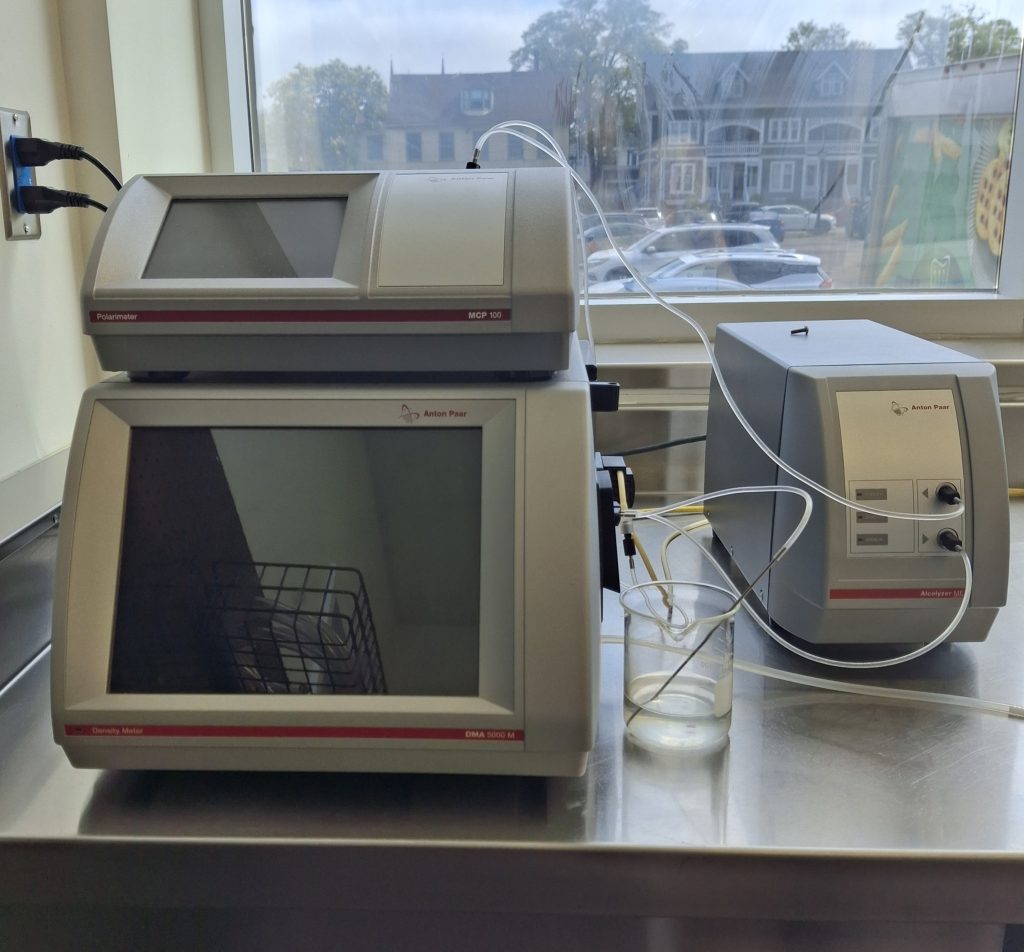
The Anton Paar Density Meter provides fast, precise and reliable density measurements for food, beverage and product development applications. With automated measurement, temperature compensation and excellent repeatability, it enables R&D teams to accurately evaluate formulations, monitor product consistency and support quality control while using minimal sample quantities.
FEATURES
- High-precision density measurement – Provides accurate measurement of liquid density for product development and quality control
- Digital measurement technology – Delivers fast, reliable results with minimal manual calculation
- Temperature control and compensation – Helps ensure accurate readings across different sample temperatures
- Automated measurement process – Simplifies operation and improves consistency between measurements
- Small sample requirements – Allows testing with relatively small quantities of product, which is ideal for R&D applications
- Wide range of applications – Suitable for beverages, food products, syrups, oils, sauces and other liquid formulations
- Repeatable results – Supports consistent testing during formulation development and quality evaluation
- Easy-to-use interface – Designed for straightforward operation and efficient laboratory workflows
BENEFITS
- Improves product consistency by providing precise density measurements between batches and formulations
- Supports formulation development by helping researchers evaluate and compare different product compositions
- Saves time through fast, automated measurements compared with traditional density-testing methods
- Reduces sample waste because only a small quantity may be required for testing
- Improves quality control by providing reliable data that can be used to monitor product specifications
- Helps identify formulation changes that may affect concentration, composition or product performance
- Provides objective, measurable data to support R&D decisions and product optimization
- Ideal for food and beverage development where density can be an important indicator of formulation and consistency